Showing posts with label pre-K. Show all posts

Wednesday, October 31, 2012

Children’s play and play-based learning should be the fundamental philosophy behind early learning environments...


Whether by necessity or choice, the majority of parents work and many depend upon formal, organized out‐of‐home care.  Offering quality child care that supports the child’s natural desire to play and provide an environment that is intentional about creating opportunities for learning through play helps create a common good society.  Quality early care and education programs that follow a pedagogy of play support a child’s optimal development and readiness for success in school. Longitudinal research
(e.g. Chicago Child‐Parent Centers, High/Scope Perry Preschool and Abecedarian Projects) shows that children who attend high‐quality preschool programs are less likely to be placed in special education; less likely to be held back a grade; and more likely to graduate from high school and attend college.

A play-based child care program, like the one You’re Invited provides, is one that allows children to learn at their own individual pace through the natural process of play.  The profound benefits of this type of learning environment are losing ground to adult-directed, instruction based philosophies.  Important life-long skills such as problem solving, emotional development, divergent thinking, analytical skills, etc are being put to the side for worksheets, drills, table work and other developmentally inappropriate teaching styles.

Problem solving, for instance, involves an element of risk. If we want children to learn to solve problems we must create safe environments in which they feel confident taking risks, making mistakes, learning from them, and trying again (Fordham & Anderson, 1992). In a play-based curriculum, each day provides opportunities to learn about reading, writing, and math through real, meaningful situations. For instance, children set the table for snack so each child has one napkin, one straw, and one box of milk. Children string beads to match the pattern on a card or wait their turn because there is room for only four children at the art table. Through these meaningful experiences children begin to understand number, quantity, size, and other mathematical concepts.

It is clear the expectations of our society are changing and our culture is becoming increasing focused on specific functional skills such as arithmetic and pre-literacy as the objective of pre-kindergarten learning environments.  We feel children’s play and play-based learning should be the fundamental philosophy behind early learning environments and will continue to offer an environment that is proven to provide the most solid foundation for acquiring these functional skills when developmentally appropriate. 

Fordham, A.E. & Anderson, W.W. (1992). Play, risk-taking, and the emergence of literacy. In Play's place in public education for young children, edited by V.J. Dimidjian, 105-114. Washington, DC: National Education Association.

Tuesday, September 14, 2010

"MMMM this smells goooood!"

Yogurt Painting
We mixed watercolor with plain yogurt for a different type of painting experience. I added tools (q-tips, combs, playdough rollers, etc) and used aluminum foil because I thought the colors would pop more than on construction paper or cardboard and its sturdy enough.
This is definitely a process art project, when the friends were done with their experience we threw the foil away and put out a fresh sheet for the next friend. I accidently deleted a great pic of one of the friends with both pf her hands all the way in the paint cups scooping the yogurt paint out. Who needs paint brushes right? :)


Friday, August 27, 2010

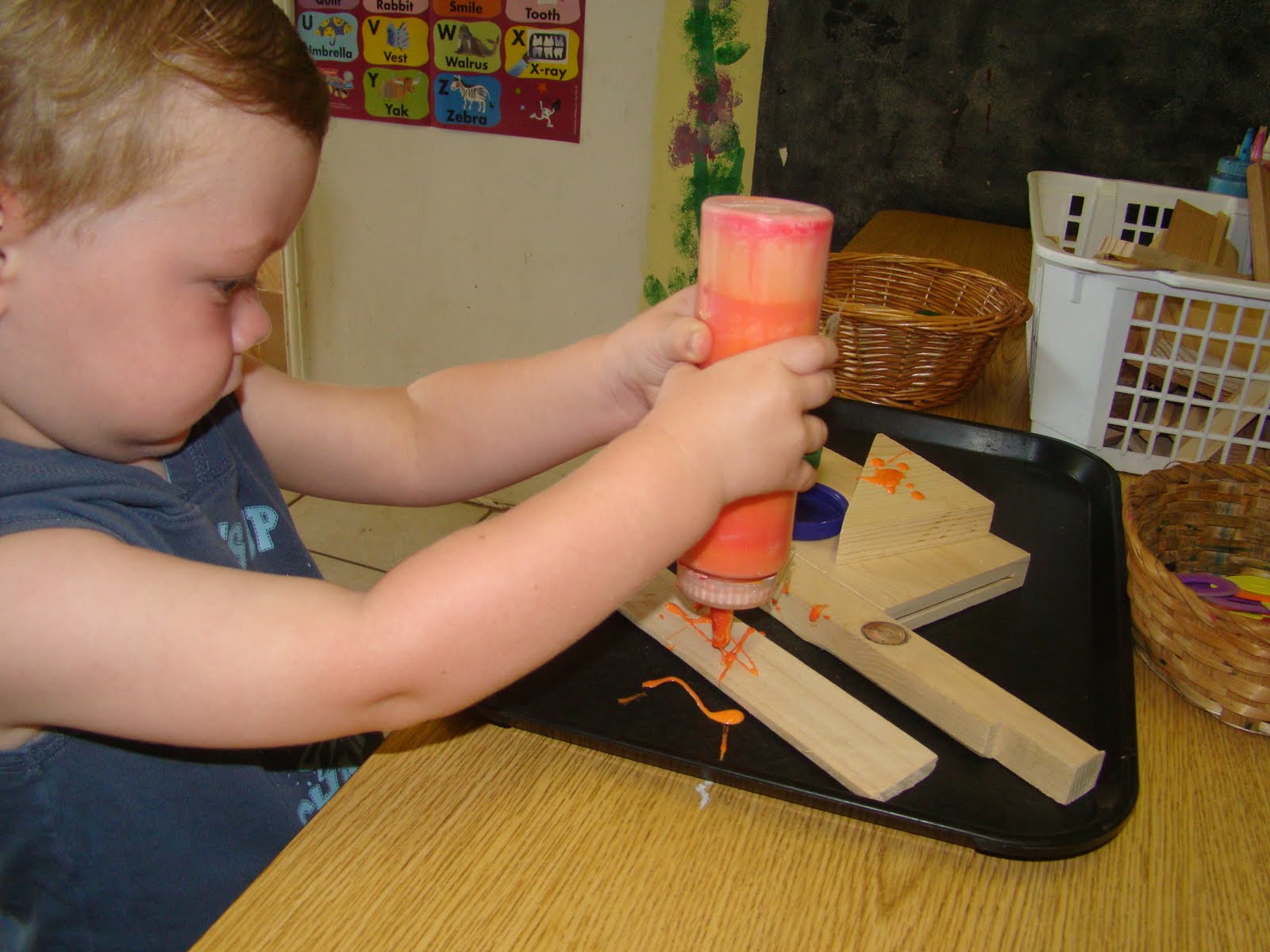
Squeeze bottles and Wood for All Ages!!

Great three dimensional activity for all ages!!


The set up for this activity (and all activties we do) is super important. We use trays to help the friends know their boundaries and the table is inviting with baskets to keep the loose parts accessible and neat. Throughout the morning theteachers are constantly straightening, cleaning and refilling the baskets, facilitating the activity to be "inviting" when a child comes upon the table so then he or she will decide they want to engage in this activity. We have 2 year olds, three year olds and four year olds doing this activity, working hard, engaged in their creative process.

This friend tells me while he is working hard: "I made a bridge!" I asked him, "Whats the bridge for?" He says "For the people to walk across the lake and not fall in the water"


"Look, its a slide, for the bridge, WAIT I need green"
So much concentration and intentionality with squeeze bottles filled with white paint, a little glue and some water color.

Wednesday, August 18, 2010

Great Shape Math Activity!

$ bin at Target has some great treasures! I found these great little square, cylinder and triange foam blocks and created these boards with cereal box cardboard and construction paper. The friends at You're Invited worked with these materials for the whole morning :)


There are so many skills these friends are working on!


Patterns, eye-hand coordination, sequencing, estimating, color matching, counting, seriation, cooperation...

Can you list more skills this super low cost but great activity provides?

Wednesday, June 23, 2010

Stained glass fun!!!

Tissue Shapes and a Big Window = Stained Glass!!
Im always looking for ways do an old activity a new way! Thanks to Filth Wizardry I decided to turn our big window into a place of creativity for my friends. A great way to use arm muscles, divergent thinking, using tools in new ways, creative thinking and it makes a beautiful window that we got tons of compliments on.

I cut tissue paper into different shapes, clear glue in cups, paint brushes and our big window!


Friday, April 9, 2010

More Spring Activities!!

The children at You're Invited loved creating these flowers! I wish I could remember which blog I saw the use of the paper towel rolls (I promise to remember next time I post a borrowed activity) as flower petals. Flatten the paper towel roll before you cut it. Use water/milk/soda bottle lids and any fabric or construction paper for stem and leaves. It was great to watch the friends concentrate their eye-hand coordination to get the glue on the thin sides of the paper towel roll petals.


Im constantly asked by preschool teachers about 3 dimensional art activities because it is required in the ECERS Art item to get a 7. This is a great spring art idea!!
Be prepared for a lot of glue to be used :)!!


Monday, August 24, 2009

Magnet Fun!!

3-D magnet fun & learning!

We used coffee cans, letter magnets,
magnet wands, magnet marbles and a bunch of random magnets for fun! The next time I offer this activity I am going to use even bigger coffee cans and I am on a hunt for different types of magnets!
This activity provides letter and number recognition, creative expression, small muscle development, cause and effect, and is a science activity!

Noah puts all the letters of his name on the coffee can above and Kaleb finds his letter on the right :)

Wednesday, August 12, 2009

More Preschool Bug Activities!

Children need real experiences to build optimal foundations for learning! We provided real crickets, meal worms and red worms to look at, talk about and write about!
I realized after I took this picture of friends at the table of worms that it showed the beauty of mixed-age environments. The children exploring the worms with tweezers and magnifying glasses are two, three, four and five years old and they
discussed and explored for almost 30 minutes together!

A writing table with different writing tools, bug stickers, paper and staplers to make homemade books , etc
Working with the different ages, some children told their bug/insect stories and some wrote their own!

Saturday, July 4, 2009

Bugs & Insects

At You're Invited Children's Center we have had some great experiences learning about bugs and insects in the last few weeks. These are some of the activities that were successful and easy for you to provide for your children too:


Gummy Worms & Coffee Sand
You will love the reaction your children (and you!) have when you smell the coffee sand and gummy worms used in this activity. The main goals for this activity are to strengthen their small muscles (important for pre-writing) with the tweezers and develop eye-hand coordination. Coffee sand is easy to make and the aroma is wonderful. There are baskets in the middle for children to place the gummy worms.

Coffee Sand recipe: 4 c. dried used coffee grounds 2 c. cornmeal 1 c. flour 1/2 c. salt
Dry coffee grounds either by placing in cookie sheets and put in oven for about 20 minutes or leaving out over night. Once coffee gounds are dry mix all ingredients in large tub.

You can get the children involved in preparing this by letting them pour ingredients into large tub then give them potato mashers to mix (great for large muscle development)! There is a lot of mixing involved because the ingredients clump.
Entomology Kits
These bags are easy to put together and great to have around for children to use any time their curiousity leads them! An entomologist or a bugologist (Bug-hunter) is a person that studies insects!

With this kit, your child can be a true entomologist?

You need:
1. Small bag (u can use canvas bags found at craft stores, my friend quickly sewed these for us)
2. Clear small container with holes in it - we reused our
3. Notebook with pencil
4. Tweezers
5. Magnifying glass

Children use the notebooks to "write" about their findings and teachers can also dictate what the children talk about. One of our teachers heard:

"We picked up with the tweezers, we found pincher bugs. Wow little worm, easy little worm, you're just a baby. Take it easy little guy, I won't hurt ya, I just want to look
at ya." - Andrew, age 5

Spider on a Web
I love activities for children that involve several steps. Two years olds and the older kids can do this activity.
It starts with the children marble painting a black circle with white paint (put a little glue in the paint) - this is the web!

The second step is making the spider for the web

1. Provide pre-cut circles and put out hole punchers. The older children love using this tool while the younger children might need some help. You can talk about how many legs spiders have and thats how many holes they need to punch.
2. Children fold pipe cleaners through each hole
3. Glue eyes on

Third step is to glue the spider on the web!!!